

Crop Pest & Disease Intelligence Series The Fall Armyworm Crisis in Maize

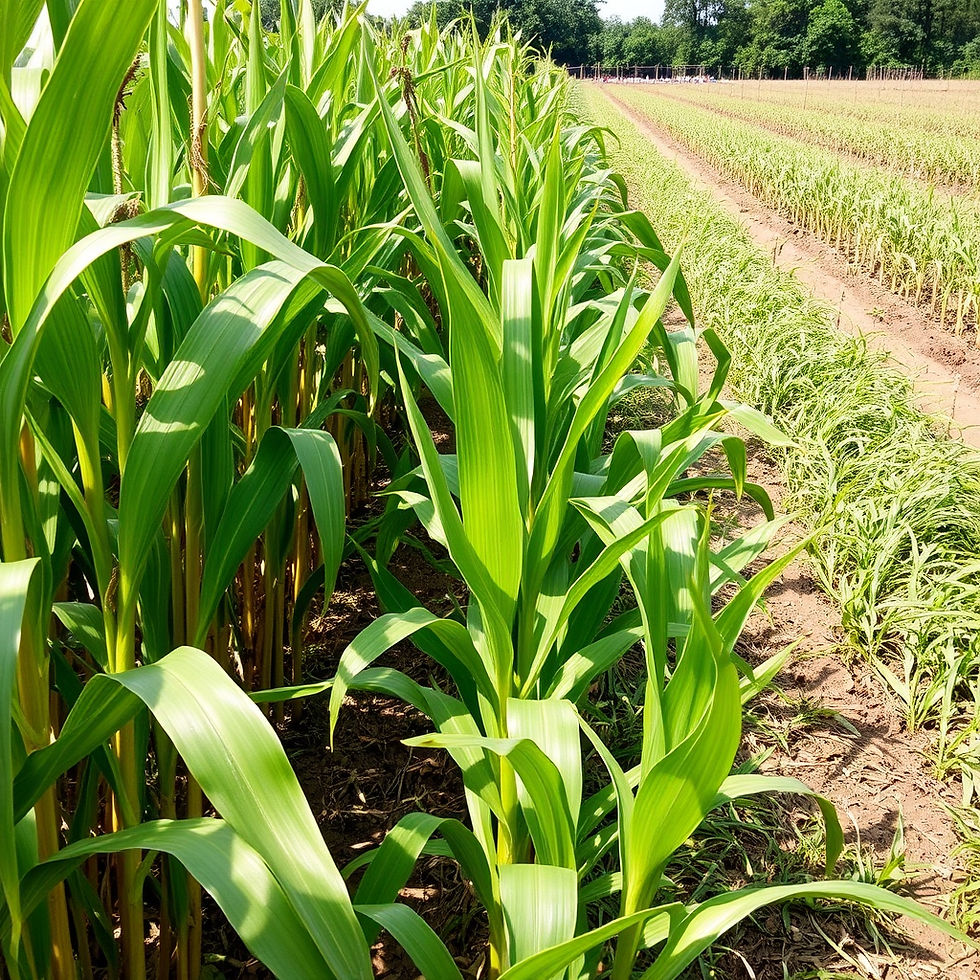
The Fall Armyworm (FAW), or Spodoptera frugiperda, represents a paradigm shift in tropical pest management. Since its catastrophic introduction to Sri Lanka in late 2018, it has evolved from a sporadic invader to a persistent, endemic threat. Unlike native pests, the FAW possesses a unique combination of high reproductive plasticity, a lack of diapause (no dormant period), and a "corn-strain" genetic dominance that makes it exceptionally efficient at colonizing maize monocultures.
For the modern agricultural professional, managing FAW is a game of Thermal Units and Economic Thresholds (ETL).
Affected Regions: The Sri Lankan Hotspots
Research conducted by the Department of Agriculture and independent academic studies consistently highlight the Uva Province (Monaragala) and the North Central Province (Anuradhapura) as high-intensity zones.
The Uva Crisis: During the initial outbreaks, infestation rates in Uva reached as high as 73% in some Maha seasons.
Irrigation Zones: Recent 2026 data indicates a 4.3-fold increase in FAW incidence in irrigated maize fields during the dry season compared to rain-fed fields. Irrigation creates a "perpetual summer" for the pest, allowing it to bypass seasonal population crashes.
The Life Cycle: A Function of Thermal Accumulation
The FAW does not follow a calendar; it follows a thermometer. Its development is measured in Degree Days (DD).
Optimal Velocity: Research shows the shortest life cycle occurs at 35^\circ C (approx. 18–19 days), while at 20^\circ C, the cycle stretches to 60 days. In Sri Lanka’s typical 25^\circ C to 30^\circ C range, a new generation emerges every 24 to 30 days.
Fecundity: A single female peaks at 30^\circ C, laying an average of 764 eggs, though laboratory maximums have reached over 1,500.
Thermal Constant: The estimated thermal constant for total development from egg to adult is approximately 466.06 degree days.
Favorable Conditions & The "Green Bridge"
The persistence of FAW in Sri Lanka is fueled by two primary factors:
Continuous Reproduction: Due to the absence of frost or extreme cold, FAW reproduces year-round.
The Green Bridge: Recent studies in Frontiers in Plant Science (2026) show that non-maize hosts like Finger Millet (Kurakkan), Sorghum, and even Sugarcane act as "bridges." When maize is harvested, the population survives on these secondary hosts, ensuring a massive "carry-over" population for the next season.
Advanced Identification: The Clinical Stages
Effective Integrated Pest Management (IPM) requires scouting at specific growth stages (V2 to V12).
V2-V4 (Seedling Stage): Look for Window-Pane Damage. This is a "non-perforating" feeding style where the 1st and 2nd instar larvae consume only the green parenchyma.
V6-V10 (Whorl Stage): The larvae become "cannibalistic," usually leaving only one or two large larvae per whorl. You will observe Ragged Holes and heavy Frass (Excrement).
R1-R3 (Reproductive Stage): The most economically damaging phase. Larvae bore directly into the ear (cob). In some regions, cob damage has been recorded as high as 67%, directly impacting the grain quality and market weight.
The CYOL Intelligence Framework: Data-Driven Defense
Traditional "blanket spraying" is increasingly ineffective due to emerging pesticide resistance and the high cost of inputs. Cyol implements a Precision IPM (P-IPM) approach:
1. Predictive Risk Forecasting (The DD Model)
Cyol utilizes local temperature sensors to calculate Accumulated Heat Units. By knowing when the "Degree Day" threshold for moth emergence is met, we send alerts to farmers to begin high-intensity scouting exactly when the next generation is expected to hatch.
2. Digital Scouting & ETL Optimization
We assist farmers in calculating the Economic Threshold Level (ETL).
Rule of Thumb: If 10% of plants show damage in the seedling stage, or 20% in the whorl stage, Cyol triggers a "Treatment Recommended" status. This prevents unnecessary chemical costs.
3. Integrated Bio-Control Recommendations
Cyol promotes the "Integrated Approach" proven in recent on-farm trials:
Botanical Extracts: Using Neem (Azadirachta\ indica) and Moringa extracts has shown up to 80% mortality in early-stage larvae.
Pheromone Trapping: We recommend installing 8–10 pheromone traps per acre to monitor male moth density, which serves as a 10-day forewarning signal for egg-laying.
Mechanical Barriers: Encouraging the application of sand or wood ash into the whorl to physically abrade the larval skin and cause desiccation.
By combining ancient wisdom with real-time digital intelligence, Cyol ensures that Sri Lankan maize farmers aren't just reacting to the Fall Armyworm—they are out-calculating it.


Comments