

The Architecture of Abundance: A Technical Deep-Dive into Integrated Crop Management (ICM) for Paddy

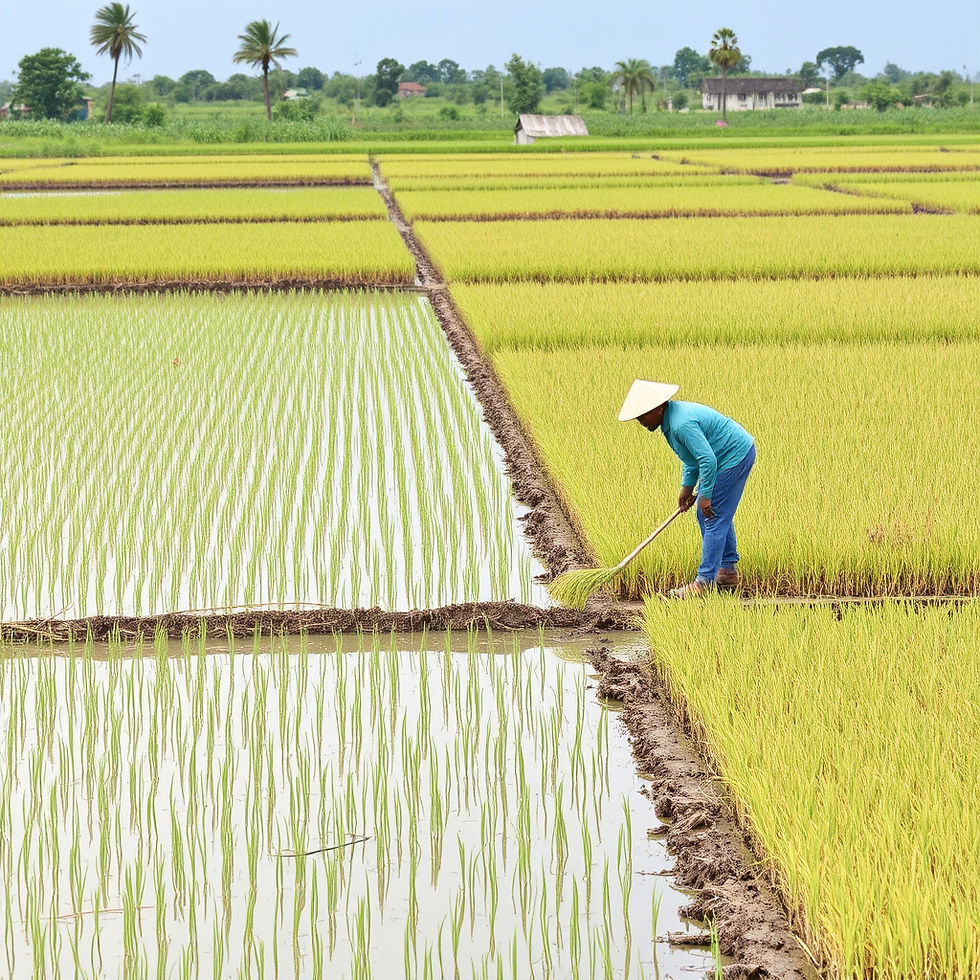
Integrated Crop Management (ICM) represents the evolution of agronomy from a collection of isolated tasks into a high-precision, data-driven system. In the context of Sri Lankan paddy cultivation—where land fragmentation and climate volatility pose significant risks—ICM serves as a strategic framework to maximize Resource Use Efficiency (RUE).
Unlike traditional "Fixed-Schedule" farming, ICM is a responsive system. It dictates that every intervention—whether chemical, biological, or mechanical—must be justified by the current physiological state of the crop and the prevailing environmental conditions.
1. The Holistic Farm Management Approach: Systems Thinking
In a research-based ICM model, the paddy field is analyzed as a closed-loop ecosystem. The goal is to minimize external "leaks" (such as nutrient runoff into waterways) and maximize internal synergies.
Soil-Plant-Water Nexus: ICM recognizes that soil health dictates nutrient uptake, which in turn is governed by water availability. For instance, in an ICM system, phosphorus application is timed specifically for when soil moisture is optimal, ensuring the mineral reaches the root zone rather than being "fixed" in the soil crust.
Biological Synergy: By maintaining "Refugia" (strips of natural vegetation) around paddy tracts, ICM farmers encourage the presence of Odonata (dragonflies) and Araneae (spiders), which provide "free" pest suppression services, reducing the need for synthetic neurotoxins.
2. The Triad of Integration: Water, Nutrients, and Pest Dynamics
The hallmark of a high-quality ICM program is the simultaneous management of three variables that are usually handled separately.
A. Advanced Water Management (AWD)
The "Alternate Wetting and Drying" (AWD) technique is a cornerstone of research-based ICM.
The Science: By allowing the water level to drop to 15 cm below the soil surface before re-flooding, the soil is oxygenated. This stimulates Aerenchyma development in the roots, making the plant physically stronger and more resistant to "lodging" (falling over) during high winds.
The Benefit: AWD can reduce water consumption by up to 30% and significantly lower methane emissions, making the farm more environmentally sustainable.
B. Site-Specific Nutrient Management (SSNM)
ICM moves away from "Blanket Recommendations" (the same fertilizer for everyone).
The Leaf Color Chart (LCC): This simple research tool allows farmers to measure the "Real-Time Nitrogen Status" of the plant. If the leaves are a certain shade of green, nitrogen is withheld, preventing the lush, soft growth that attracts pests like the Brown Plant Hopper (BPH).
Balanced Nutrition: ICM emphasizes the role of Silicon (Si) and Potassium (K) to thicken cell walls, providing a physical barrier against fungal pathogens.
C. Integrated Pest Management (IPM) & The Economic Threshold
In an ICM system, a pest is not an "enemy" until its population reaches the Economic Threshold Level (ETL)—the point where the cost of the damage exceeds the cost of treatment.
Conservation of Natural Enemies: Broad-spectrum pesticides are avoided to protect "beneficials."
Pheromone and Light Traps: These are used as "Intelligence Tools" to monitor pest migrations before they become outbreaks.
3. Growth Stage-Based Management: The Physiological Roadmap
Successful ICM requires a "Clinical" understanding of the three primary phases of the paddy life cycle:
Phase | Duration (Approx.) | Critical ICM Focus |
Vegetative | 45–60 Days | Tillering & Rooting: Focus on early N-application and mechanical weeding to prevent nutrient theft by weeds. |
Reproductive | 30 Days | Panicle Initiation: This is the "Goldilocks Zone." Water must be constant (5–7 cm). Any stress here results in "spikelet sterility." |
Ripening | 30 Days | Grain Filling: Potassium is key. Gradual field drying (terminal drainage) is initiated to harden the grain and prepare for mechanization. |
4. Yield Optimization and Loss Mitigation
Research shows that the "Yield Gap"—the difference between a researcher's plot and a typical farmer's field—is usually 20-40%. ICM closes this gap by:
Reducing Post-Harvest Loss: By monitoring grain moisture content accurately before harvest, ICM prevents "shattering" in the field and "cracking" during the milling process.
Optimizing Photosynthetic Efficiency: Through proper plant spacing (row planting), ICM ensures that sunlight reaches the lower leaves, increasing the overall "Harvest Index."
5. CYOL Integration: The Digital Evolution of ICM
Managing these variables manually is a heavy cognitive load for any farmer. Cyol acts as the "Decision Support System" that makes ICM practical and scalable.
Field Activity Tracking & Auditing: Cyol provides a digital ledger where every input is timestamped. This is essential for farmers seeking "Good Agricultural Practices" (GAP) certification, which can lead to higher export prices.
Yield Monitoring & Heat Mapping: By analyzing harvest data, Cyol identifies "Underperforming Zones" in your field. If a specific 10-meter patch consistently yields less, Cyol helps you investigate if the cause is localized salinity or poor drainage.
Predictive Performance Analytics: Using machine learning, Cyol compares your current season's data against thousands of successful cycles. If your tillering rate is lagging behind the "Golden Standard" for your region, the system sends an automated diagnostic alert with corrective actions.
Integrated Crop Management is more than a technique; it is a commitment to agricultural excellence. With Cyol, you have a research-grade laboratory in your pocket, ensuring that every paddy field is a masterpiece of efficiency and resilience.


Comments